
How to Make Money Trading With Prop Firms – Step-by-Step Guide (2026)
Let me ask you something. What if you could trade $100,000 worth of capital in the stock market without actually having $100,000?
That’s not a fantasy. That’s prop firm trading, and in 2026, it’s one of the most legitimate ways for skilled traders to turn their market knowledge into real, consistent income. No rich uncle. No risky personal savings. Just your skill, their capital, and a profit split that works in your favor.
But here’s the thing: prop trading isn’t a shortcut. It’s a system. And if you don’t understand how that system works, you’ll blow your challenge account faster than you can say “margin call.”
In this article, I’ll break it all down. From what prop firms actually are, to the best ones to join right now, to a step-by-step blueprint for going from zero to funded trader. Buckle up.
Disclaimer: Trading involves significant risk of loss. Prop firm challenges do not guarantee funding or profitability. Always trade with capital you can afford to lose and consult a financial advisor if needed.
What Does It Mean to Make Money Trading With Prop Firms?
At its core, proprietary trading (or prop trading) means you’re trading a firm’s capital instead of your own. The firm gives you access to a funded account; you trade it, and you and the firm split the profits.
Simple enough, right?
The beauty of this model is that your risk exposure is extremely limited. You pay a one-time challenge fee, often anywhere from $50 to a few hundred dollars, and in return you get access to accounts worth $10,000, $50,000, or even $200,000.
If you follow the rules and hit your profit targets during the evaluation phase, you get funded with real (or simulated) capital and start earning payouts.
The catch? You have to prove yourself first. That’s the challenge phase.
How Do Prop Firms Actually Pay You?
Here’s what every aspiring prop trader wants to know: how does the money flow?
Most prop firms operate on a profit split model typically ranging from 70/30 to 90/10 in the trader’s favor. So if you generate $5,000 in profits on a funded account with an 80% split, you walk away with $4,000. The firm keeps $1,000.
Payouts are usually processed on a cycle bi-weekly being the most common and you’ll need to hit a minimum profit threshold (often around $300) before you can withdraw. Most firms also require you to complete KYC (Know Your Customer) checks before your first payout gets processed.
And yes, the payouts are real. Thousands of funded traders post verified payout proof every single week.
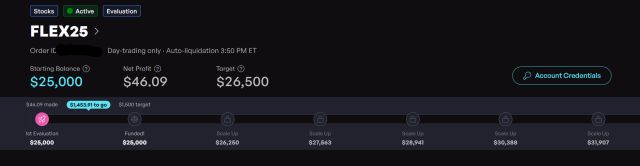
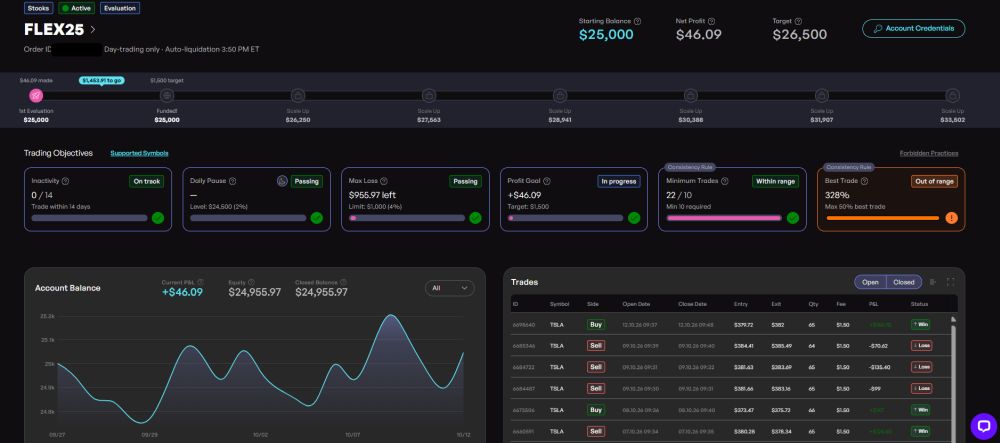
Currently, I’m in the process of passing my first evaluation for $25,000 with Trade The Pool. With this prop firm challenge, I need to earn 6% or $1500. If I lose more than 4% of the capital, or $1000, I lose the account and will have to buy another account.
Do You Need Your Own Capital?
Technically? No. Practically? A little.
You don’t need to fund a brokerage account with your own money. But you do need to pay the evaluation/challenge fee, which acts as the cost of entry.
Think of it like paying tuition to prove you deserve the firm’s capital. Most challenge fees are refunded with your first payout, so it’s more of a deposit than a sunk cost provided you pass.
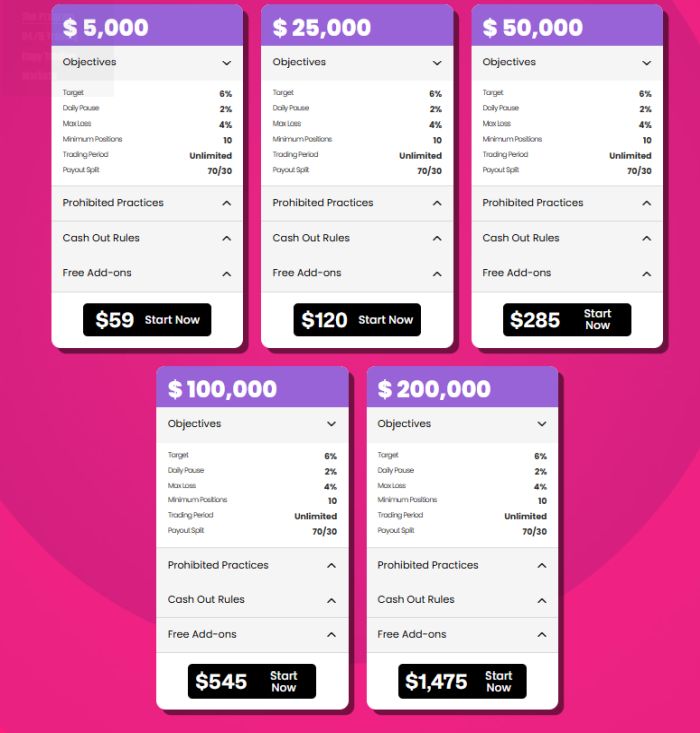
With Trade the Pool, these fees run $59 to $ 1,475 for the flex accounts.
Top Prop Firms to Know in 2026
The prop firm space has exploded in recent years. Here’s a curated look at the best ones right now, each suited to different trading styles.
| Prop Firm | Best For | Profit Split | Account Sizes | Key Feature |
|---|---|---|---|---|
| Trade The Pool | US Stocks & ETFs | Up to 80% | $5K–$200K | Real stock trading via IBKR |
| FTMO | Forex & Multi-Asset | Up to 90% | $10K–$200K | Most established, globally recognized |
| Topstep | Futures | Up to 90% | Various | Trading Combine model |
| The5ers | Forex, Long-term scaling | Up to 100% | $6K–$100K | Gradual scaling focus |
| FundedNext | Beginners, Forex | Up to 90% | $6K–$200K | Low challenge fees |
Let’s zoom in on a few of these.
🏆 Trade The Pool — Best for Stock Traders
If you’ve been grinding the forex prop firm space and wondering, “wait, can I do this with actual stocks?” Trade The Pool is your answer.
Founded in 2022 and backed by the team behind The 5%ers, Trade The Pool is genuinely unique in the prop firm world.
While almost every other firm focuses on forex, futures, or CFDs, Trade The Pool is built exclusively for U.S. stocks and ETFs. And not simulated ones you’re accessing real market data through Interactive Brokers (IBKR), one of the most reputable brokers on the planet.
Here’s what makes TTP stand out:
- Account sizes from $5,000 to $200,000 in buying power
- Challenge fees starting at just $47 — accessible for almost any budget
- Single-phase evaluation (no multi-step headaches)
- Profit split up to 80% — starting at 70% for most accounts
- No time limit on Flex programs — trade at your own pace
- Bi-weekly payouts every 14 days, minimum $300 withdrawal
- Swing trading allowed — including overnight and weekend holds
- Trader Evolution platform — professional-grade with DOM, scalper view, and more
The evaluation targets are clear: for Day Trade accounts, you’re looking at a 6% profit target with dollar-based daily pause and max loss limits. Swing accounts have a 15% target with more room to breathe. There are some rules to be aware of, including a 30-second gap between trades and a 10-cent minimum profit per share, but they’re consistent and well-documented.
Scaling at TTP works like this: hit a 10% profit target on your funded account and your buying power increases by 5%, with your daily allowance bumping up 10% too. The scaling compounds, so the better you get, the more capital you’re playing with.
Who is Trade The Pool for? Equity traders who know U.S. stocks, understand sector rotation, and want to trade real shares in real markets, not synthetic CFDs. If that’s your edge, TTP might just be your home base.
“Trade The Pool is hands down the best prop firm for stock traders.” — Verified Trustpilot Review
FTMO — The Gold Standard of Forex Prop Firms
When people talk about prop firms, FTMO is usually the first name that comes up, and for good reason. They’ve been around since 2015 and have paid out hundreds of millions of dollars to traders worldwide.
FTMO offers a two-step evaluation (the FTMO Challenge + Verification), after which traders access funded accounts with profit splits up to 90%.
They support MetaTrader 4, MetaTrader 5, and cTrader, giving you plenty of platform flexibility. The rules are strict but transparent, and their track record is hard to argue with.
Topstep — King of Futures Prop Trading

Futures traders, this one’s for you. Topstep uses a “Trading Combine” model where you prove your skills over a defined period before getting funded.
They specialize in CME futures, including ES, NQ, CL, and more. Their platform integrations include NinjaTrader and Tradovate, both industry staples.
The5ers — Built for the Long Game

The5ers is the parent company of Trade The Pool and one of the most respected prop firms for forex traders. Their focus is on long-term scaling rather than quick payouts.
If you’re a patient trader who wants to grow steadily from a smaller account to six-figure funding, The5ers’ progressive model is hard to beat.
The Complete Step-by-Step Guide to Making Money With Prop Firms
Alright. Here’s the part you actually came for. Let’s walk through the full process from total beginner to funded, paying trader.
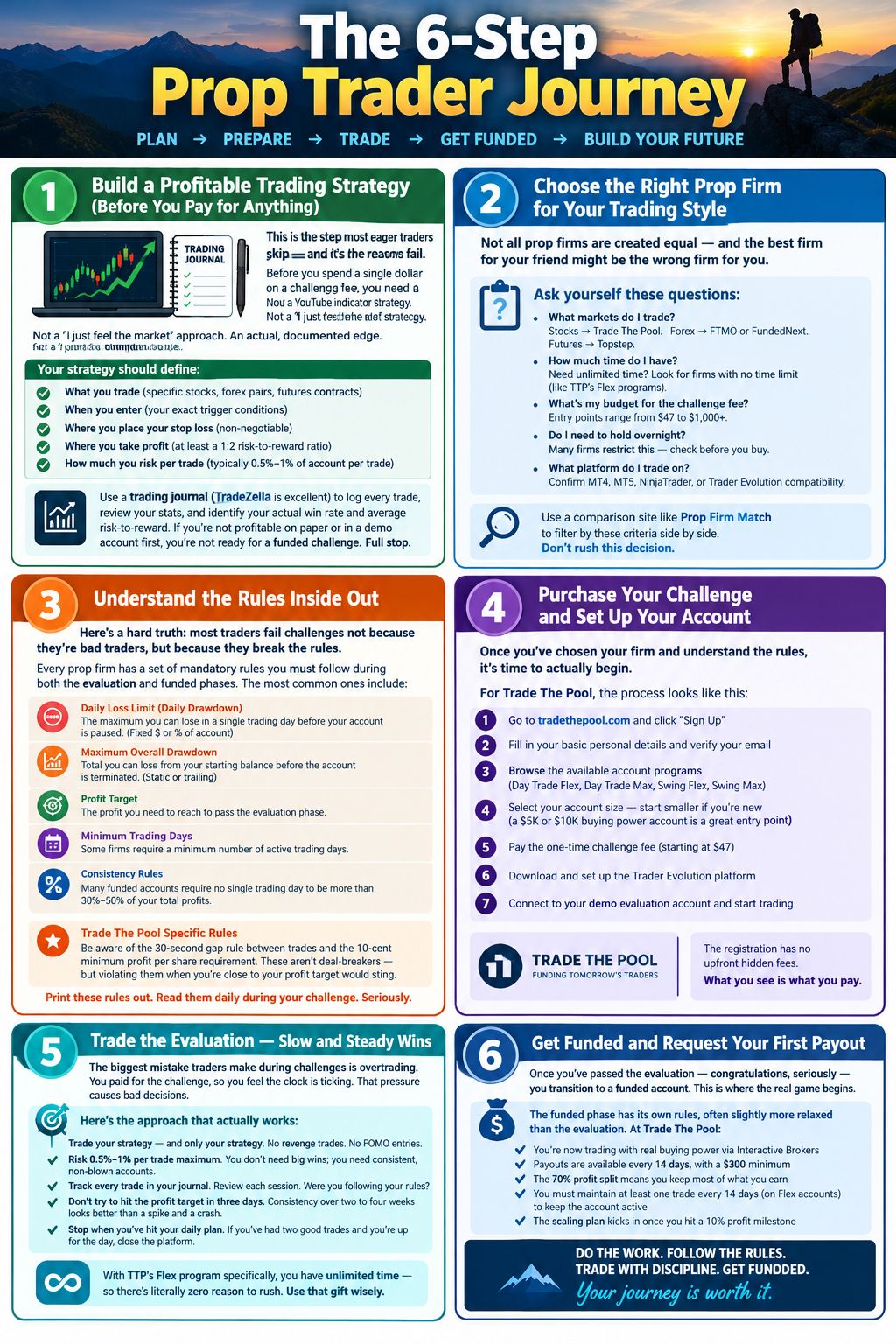
Step 1: Build a Profitable Trading Strategy (Before You Pay for Anything)
This is the step most eager traders skip, and it’s the reason most challenges fail.
Before you spend a single dollar on a challenge fee, you need a proven, backtested strategy. Not a YouTube indicator strategy. Not a “I just feel the market” approach. An actual, documented edge.
Your strategy should define:
- What you trade (specific stocks, forex pairs, futures contracts)
- When you enter (your exact trigger conditions)
- Where you place your stop loss (non-negotiable)
- Where you take profit (at least a 1:2 risk-to-reward ratio)
- How much you risk per trade (typically 0.5%–1% of account per trade)
Use a trading journal (TradeZella is excellent for this) to log every trade, review your stats, and identify your actual win rate and average risk-to-reward. If you’re not profitable on paper or in a demo account first, you’re not ready for a funded challenge. Full stop.
Step 2: Choose the Right Prop Firm for Your Trading Style
Not all prop firms are created equal, and the best firm for your friend might be the wrong firm for you.
Ask yourself these questions:
- What markets do I trade? Stocks → Trade The Pool. Forex → FTMO or FundedNext. Futures → Topstep.
- How much time do I have? Need unlimited time? Look for firms with no time limit (like TTP’s Flex programs).
- What’s my budget for the challenge fee? Entry points range from $47 to $1,000+.
- Do I need to hold overnight? Many firms restrict this — check before you buy.
- What platform do I trade on? Confirm MT4, MT5, NinjaTrader, or Trader Evolution compatibility.
Use a comparison site like Prop Firm Match to filter by these criteria side by side. Don’t rush this decision.
Step 3: Understand the Rules Inside Out
Here’s a hard truth: most traders fail challenges not because they’re bad traders, but because they break the rules.
Every prop firm has a set of mandatory rules you must follow during both the evaluation and funded phases. The most common ones include:
- Daily Loss Limit (Daily Drawdown): The maximum you can lose in a single trading day before your account is paused. This is usually a fixed dollar amount or a percentage of your account balance.
- Maximum Overall Drawdown: The total you can lose from your starting balance before the account is terminated. This can be static (fixed from opening balance) or trailing (follows your highest balance).
- Profit Target: The profit you need to reach to pass the evaluation phase.
- Minimum Trading Days: Some firms require a minimum number of active trading days before you can pass.
- Consistency Rules: Many funded accounts require that no single trading day accounts for more than 30%–50% of your total profits.
At Trade The Pool specifically, you also need to be aware of the 30-second gap rule between trades and the 10-cent minimum profit per share requirement. These aren’t deal-breakers but violating them when you’re close to your profit target would sting.
Print these rules out. Read them daily during your challenge. Seriously.
Step 4: Purchase Your Challenge and Set Up Your Account
Once you’ve chosen your firm and understand the rules, it’s time to actually begin.
For Trade The Pool, the process looks like this:
- Go to tradethepool.com and click “Sign Up”
- Fill in your basic personal details and verify your email
- Browse the available account programs (Day Trade Flex, Day Trade Max, Swing Flex, Swing Max)
- Select your account size — start smaller if you’re new (a$25k buying power account is a great entry point)
- Pay the one-time challenge fee (starting at $120)
- Download and set up the Trader Evolution platform
- Connect to your demo evaluation account and start trading
The registration has no upfront hidden fees. What you see is what you pay.
Step 5: Trade the Evaluation — Slow and Steady Wins
The biggest mistake traders make during challenges is overtrading. You paid for the challenge, so you feel the clock is ticking. That pressure causes bad decisions.
Here’s the approach that actually works:
- Trade your strategy — and only your strategy. No revenge trades. No FOMO entries.
- Risk 0.5%–1% per trade maximum. You don’t need big wins; you need consistent, non-blown accounts.
- Track every trade in your journal. Review each session. Were you following your rules?
- Don’t try to hit the profit target in three days. Consistency over two to four weeks looks better than a spike and a crash.
- Stop when you’ve hit your daily plan. If you’ve had two good trades and you’re up for the day, close the platform.
With TTP’s Flex program specifically, you have unlimited time so there’s literally zero reason to rush. Use that gift wisely.
Step 6: Get Funded and Request Your First Payout
Once you’ve passed the evaluation, congratulations- seriously, you transition to a funded account. This is where the real game begins.
The funded phase has its own rules, often slightly more relaxed than the evaluation. At Trade The Pool:
- You’re now trading with real buying power via Interactive Brokers
- Payouts are available every 14 days, with a $300 minimum
- The 70% profit split means you keep most of what you earn
- You must maintain at least one trade every 14 days (on Flex accounts) to keep the account active
- The scaling plan kicks in once you hit a 10% profit milestone
For your first payout, complete the KYC verification in your dashboard, submit your withdrawal request, and the funds are processed through the firm’s standard payment channels. Bank transfer and crypto options are typically available.
Common Rules Traders Fail — And How to Avoid Them
Let’s be real: the prop firm space has a reputation problem. Not because the firms are scams (most legitimate ones are not), but because traders consistently fail the same rules over and over.
Here are the biggest offenders:
- Blowing the daily loss limit on an emotional revenge trade — Set an alarm or hard stop if you’re approaching the daily limit.
- Hitting the max drawdown in the first week — This comes from position sizing too big. One bad day shouldn’t end your challenge.
- Violating consistency rules — If you make 80% of your profits in one trade, some firms will flag it. Spread your wins.
- Trading during high-impact news events — Many firms have restrictions around NFP, FOMC, or earnings releases. Know your calendar.
- Inactivity timeouts — Leave your account dormant for two weeks? Some firms close it. Stay active.
How Much Can You Realistically Make?
Let’s do some honest math.
Say you’re trading a $50,000 buying power account at Trade The Pool with a 70% profit split. You’re generating a steady 3% per month in realized profits, which is very realistic for a disciplined trader.
- 3% of $50,000 = $1,500/month in gross profits
- Your 70% cut = $1,050/month
Not life-changing on its own. But scale that with their scaling plan to grow to $100K, then $200K, and suddenly you’re looking at $3,000–$5,000 per month from a single funded account. And nothing stops you from holding multiple funded accounts across different firms.
The top funded traders consistently report five-figure monthly payouts. But they’re trading for two to three years at this point. This is a career, not a lottery ticket.
Are Prop Firms Legit or Scams?
The honest answer? Both exist. The industry has attracted its share of bad actors, particularly firms that make money primarily from challenge fees with no intention of funding traders.
How to spot a legitimate firm:
- Verified payout proof from funded traders on Trustpilot, Reddit, and YouTube
- Clear, documented rules with no hidden conditions
- Refundable challenge fees upon first payout
- Established track record (2+ years of operation)
- Transparent ownership and registered company details
Trade The Pool scores 4.3/5 on Trustpilot based on hundreds of verified reviews. FTMO has paid out over $200 million. These firms have real reputations to protect.
Use comparison platforms like Prop Firm Match to research firms before committing. And when in doubt, Google the firm name + “payout proof” and see what real traders say.
Can U.S. Traders Use Prop Firms?
Yes, and this is something a lot of people get confused about. Most major prop firms accept U.S.-based traders. Trade The Pool, FTMO, Topstep, and The5ers all work with traders in the United States.
However, some firms have restrictions based on specific states or certain financial regulations, so always verify your eligibility during the sign-up process. Futures-focused firms like Topstep are particularly popular with U.S. traders since futures trading is well-regulated domestically.
FAQs: Make Money Trading With Prop Firms
What is a challenge account vs. a funded account? A challenge account is the evaluation phase where you prove your trading ability under simulated conditions. A funded account is what you receive after passing; this is where you trade real (or firm-provided) capital and earn actual payouts.
What are typical profit splits at prop firms? Most firms offer 70/30 to 90/10 splits in the trader’s favor. Trade The Pool starts at 70%, scaling up to 80% for larger accounts. FTMO goes up to 90%.
What is drawdown and why does it matter? Drawdown is the reduction in your account balance from its peak. Prop firms set maximum drawdown limits; if you breach them, your account is closed. Understanding whether your firm uses a static or trailing drawdown is crucial.
Are instant funding prop firms worth it? Instant funding firms skip the evaluation and give you a funded account right away, but they often come with stricter ongoing rules and higher fees. They can be worth it for experienced traders who hate the challenge process, but do your homework on the specific firm first.
Which trading platforms do prop firms support? The most common are MetaTrader 4 (MT4), MetaTrader 5 (MT5), NinjaTrader, Tradovate, cTrader, and Trader Evolution (used by Trade The Pool). Always confirm platform compatibility before buying a challenge.
Final Thoughts: Is Prop Trading Worth It?
If you have a proven strategy, strong discipline, and a willingness to follow rules, yes, absolutely.
Prop firm trading has opened a legitimate path for skilled traders worldwide to access serious capital without risking their life savings. The model rewards competence, not luck.
And in 2026, the infrastructure has never been better from specialized firms like Trade The Pool for stock traders to global powerhouses like FTMO for forex, there’s a seat at the table for almost every trading style.
The key is to treat it like a business. Build your edge first, pick the right firm, respect the rules, and compound your wins slowly. Do that long enough, and the payouts will follow.
Ready to start? Head to Trade The Pool for stock and ETF trading, or browse Prop Firm Match to compare your options across the entire industry.
The market isn’t going anywhere. Neither is your potential. Start smart.
Disclaimer: Trading involves significant risk of loss. Prop firm challenges do not guarantee funding or profitability. Always trade with capital you can afford to lose and consult a financial advisor if needed.